Florida homeowners insurance is not a product you should buy the same way you’d buy a flight or a pair of shoes. Wind and flood risk in Florida are complicated enough that going direct to a carrier’s website can leave you with a policy that looks fine on paper and falls apart the moment you actually need it. A local independent agent isn’t an added expense; it’s the difference between a policy that matches your actual risk and one that just matches a generic policy.
Key takeaways
-
Florida homeowners face two major, separate risks, wind and flood, that are underwritten differently, priced differently, and often excluded from a standard homeowners policy in different ways.
-
Standard homeowners insurance never covers flood damage, according to FEMA’s National Flood Insurance Program (NFIP), and nearly a third of NFIP flood claims come from areas outside the highest-risk flood zones.
-
Florida law requires insurers to offer windstorm coverage, but insurers can exclude it in high-risk coastal areas and require a separate policy instead, something a direct-to-carrier purchase can easily miss.
-
Florida’s property insurance market has shifted quickly in recent years. 20 new insurance companies have entered the state since 2022. A local agent can help you actually benefit from that shift instead of missing it.
-
Most insurers, including Citizens, stop writing new policies or adding coverage anywhere in Florida once the National Hurricane Center issues a tropical storm or hurricane watch or warning, which is exactly why coverage needs to be in place before a storm is already forming.
-
A local independent agent represents multiple carriers and can compare coverage, not just price, to find you the best options tailored to your assets and risk profile.
Why Florida Homeowners Insurance Isn’t Like Other States
Most states deal with one or potentially two major property risks. Florida deals with wind and flood at the same time, on top of sinkholes in parts of the state and a legal and regulatory environment that has changed substantially in just the past few years. Rates, exclusions, and carrier appetite can vary block by block depending on elevation, distance to the coast, and construction type. A national direct-to-carrier website is typically built to sell a standardized homeowners policy at scale; it is not built to know that your specific street floods differently than the one two blocks away, or that your roof’s age just pushed you into a different underwriting tier.
That gap matters most at the two points where Florida homeowners get burned the most: wind and flood.
What an Independent Insurance Agent Does That Buying Direct Can’t
An independent agent can sell policies from many different companies, while a direct or captive agent, including the online sales team at a national carrier, sells only that one company’s products. Because a carrier’s rates are filed with state regulators, you don’t pay more by using an agent instead of buying direct. Instead, you gain is someone who can actually compare coverage, exclusions, and claims-handling reputation across multiple insurers rather than steering you toward whatever one company happens to offer.
That distinction is especially important in Florida, where wind and flood coverage rarely comes from a single, simple policy. A local agent who works in Florida every day knows which carriers are actively writing coverage in your specific county, which one requires a wind mitigation inspection before binding, and which one excludes coverage that another would include. A direct-to-carrier purchase gives you exactly one answer to all of those questions: whatever that carrier decided to sell you.
Florida Windstorm Insurance: The Coverage Gaps a Direct Purchase Can Miss
Most standard Florida homeowners policies cover wind damage from hurricanes and tropical storms, and Florida law generally requires insurers to offer this coverage. But “offered” is not the same as “automatically included the way you’d expect.” Wind coverage usually comes with a separate hurricane deductible, typically ranging from 2% to 5% of your home’s insured value rather than a flat dollar amount in 2026, which can catch homeowners off guard if nobody walks them through it. If you have a mortgage, your lender will generally require this coverage. Without one, you can often decline it, and in some high-risk coastal areas, insurers exclude wind coverage from the standard policy entirely and require a separate windstorm policy instead.
None of that is visible on a quote page that just shows you a price. It takes someone who understands your specific coastal exposure, your home’s construction, and your lender’s requirements to catch it before you’re relying on a policy that doesn’t actually respond the way you assumed it would.
Flood Insurance in Florida: The Blind Spot a Standard Policy Won’t Cover
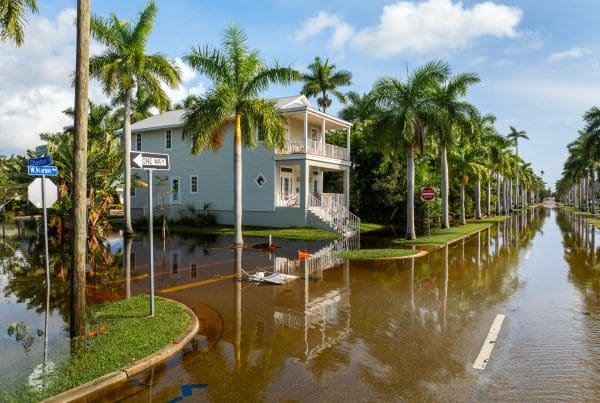
Flooding is the risk most likely to catch a Florida homeowner completely off guard, because it’s the one a standard homeowners policy simply does not cover. According to FEMA’s National Flood Insurance Program (NFIP), the federal program that provides most flood insurance in the United States, standard homeowners insurance excludes flood damage, whether it comes from storm surge or heavy rainfall. Flood coverage has to be purchased separately, either through the NFIP or a private flood carrier.
The bigger problem is assuming you’re not at risk simply because you’re not in a high-risk flood zone. From 2014 to 2024, nearly a third of NFIP flood insurance claims came from areas located outside of FEMA’s current high-risk flood zones, according to FEMA. A home outside a mapped high-risk zone can still flood, and a mortgage lender may not require flood coverage there even though the risk is real. A local agent who understands Florida’s flood zones, drainage patterns, and storm history is far more likely to flag that gap than a national website that only asks for your address and your desired coverage limit.
New flood policies also typically take 30 days to go into effect, so this isn’t something to sort out once a storm is already in the forecast.
Florida’s Homeowners Insurance Market Is Changing Fast in 2026
Florida’s property insurance market has shifted substantially over the past few years, and that shift is generally good news, but only if you have someone tracking it on your behalf. Citizens, the state-created insurer of last resort, has seen its own policy count fall to roughly 274,000 as of mid-2026, about 2% of Florida’s residential property insurance market, down from a peak of 1.4 million policies in late 2023. Since 2022, 20 new private insurance companies have entered the Florida market and taken on policies once held by Citizens.
That’s a lot of movement in a short period of time, and it means the best available coverage and pricing for your specific home may have changed since you last shopped your policy, even if you haven’t made a single claim. A local agent monitors which carriers are actively competing for business in your area and can help you actually capture that improvement. A direct-to-carrier relationship only tells you what one company is currently offering, not what else just became available.
There’s also a timing risk that a direct purchase makes worse: insurers, including Citizens, are generally barred from writing new policies or adding coverage anywhere in Florida once the National Hurricane Center issues a tropical storm or hurricane watch or warning for any part of the state. If you wait until a storm is already forming to shop for coverage or fix a gap, it may already be too late to bind it. A local agent who’s already reviewed your policy well ahead of hurricane season removes that risk entirely.
What Happens When You Get Florida Hurricane Insurance Wrong
The risk of skipping an agent isn’t just paying too much. It’s discovering after a hurricane that your wind coverage excluded the very damage you sustained, or that your homeowners policy never covered the flooding that destroyed your first floor, or that your dwelling coverage limit was never updated as your home’s rebuild cost rose. Florida law gives homeowners one year from the date of loss to file a new or reopened property insurance claim, and requires insurers to pay or deny most claims within 60 days, but none of that helps if the coverage itself was never structured to respond to what actually happened to your home.
Getting it right before a storm, not after, is the entire value of working with a local agent who understands Florida’s wind and flood risk in detail.
Frequently Asked Questions
Why do I need an insurance agent instead of buying a policy directly from a carrier?
You don’t pay more for using an agent, since rates are filed with state regulators regardless of how you buy. What you gain is someone who can compare coverage, exclusions, and claims service across multiple carriers, which matters most in a state like Florida where wind and flood risk vary block by block.
Does homeowners insurance in Florida cover flood damage?
No. Standard homeowners insurance excludes flood damage from both storm surge and heavy rainfall. Flood coverage requires a separate policy, typically through the National Flood Insurance Program or a private flood carrier.
Am I required to carry flood insurance if I’m not in a high-risk flood zone?
Not always, unless your lender requires it. However, it is strongly encouraged, as nearly a third of NFIP flood claims over the past decade came from outside high-risk flood zones, so being outside a mapped zone doesn’t mean the risk is zero.
Is windstorm coverage automatically included in a Florida homeowners policy?
In many cases, yes, though it comes with its own hurricane deductible. In some high-risk coastal areas, insurers exclude wind coverage from the standard policy entirely and require a separate windstorm policy instead, which is exactly the kind of gap a local agent is positioned to catch. Your local agent can confirm these details for your specific policy.
Is now a good time to review my Florida homeowners policy?
Yes. Reviewing your coverage with a local agent is the most reliable way to know whether your current policy still reflects the best option for your home.
Can I still buy or update Florida homeowners insurance once a hurricane is approaching?
No. Most insurers, including Citizens, stop writing new policies and adding coverage anywhere in Florida once the National Hurricane Center issues a tropical storm or hurricane watch or warning for any part of the state. Coverage needs to be reviewed and in place well before a storm is in the forecast.
Why Partner With SandStone Insurance Partners
Florida’s wind and flood risk isn’t something you should have to figure out on your own from a quote page. SandStone Insurance Partners works with multiple carriers across Florida to build homeowners coverage around your home’s actual risk, not a generic policy, and to make sure you’re not missing wind or flood gaps that only show up after a storm. Contact your SandStone advisor today for a coverage review.
Disclaimer: This blog provides general educational information about personal insurance and is not official legal, financial, or insurance advice. Coverage availability, eligibility, sublimits, exclusions, and policy features vary by state, carrier, industry, and individual underwriting. For coverage recommendations specific to your business, contact a licensed agent from SandStone.