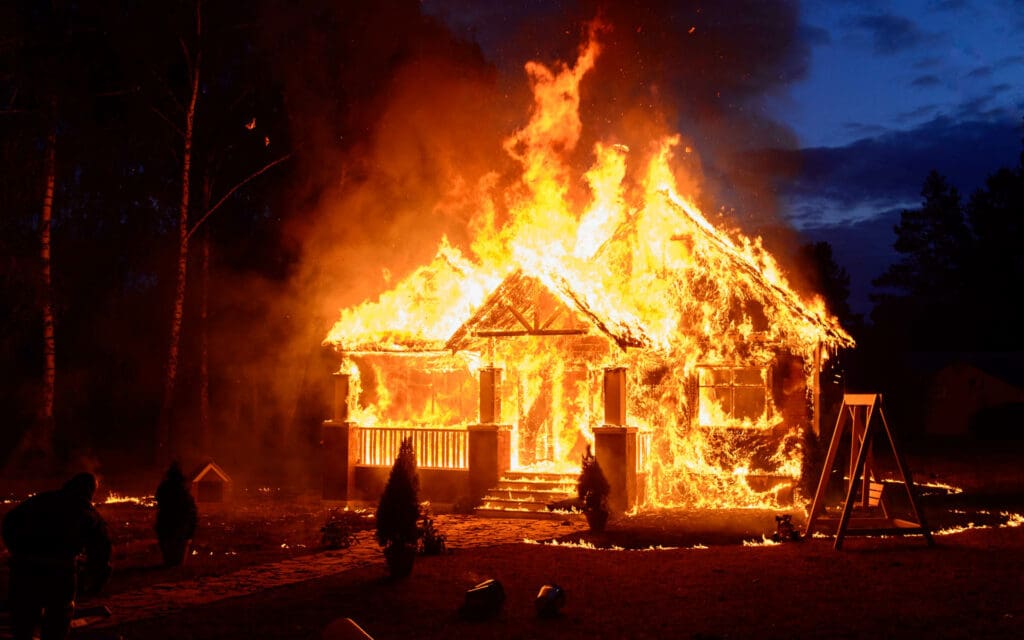
Wildfires continue to burn across South Georgia and North Florida this week, with nearly 30,000 acres in flames, 87 homes already destroyed in the Highway 82 Fire, and Governor Brian Kemp declaring a state of emergency in 91 Georgia counties. If a wildfire damaged your home or forced you to evacuate, the steps you take in the next few days directly affect your insurance payout and recovery timeline.
This guide walks you through exactly what to do after a wildfire, how to file a homeowners insurance claim, and how to avoid the mistakes that cost homeowners thousands of dollars.
What Should I Do Immediately After a Wildfire Damages My Home?
Follow these five steps as soon as authorities allow you to return safely:
-
Confirm the scene is safe before entering any damaged structure. Downed power lines, weakened roofs, and hot spots remain dangerous for days.
-
Contact your insurance agent or carrier to report the loss and start your claim.
-
Photograph and video everything before you move or throw anything away.
-
Prevent further damage with reasonable steps like boarding up broken windows or covering roof holes, and save the receipts.
-
Save every receipt for lodging, meals, clothing, and supplies you buy while displaced.
Acting fast matters. Most homeowners policies require you to report a loss “promptly” or “as soon as reasonably possible,” and some carriers set a hard deadline.
How Do I File a Wildfire Insurance Claim?
Follow this seven-step wildfire insurance claim process:
-
Report the loss. Call your agent or carrier claims hotline. Get a claim number in writing.
-
Request an advance. Many carriers issue emergency advances for additional living expenses, clothing, and essentials within days.
-
Document everything. Take wide-angle, mid-range, and close-up photos of every damaged room, wall, and item.
-
Secure the property. Tarp the roof, board windows, and remove standing water to prevent secondary damage. Save receipts.
-
Meet with the adjuster. The insurance carrier assigns an adjuster who inspects the damage and writes an estimate. Walk through the property with them.
-
Submit a Proof of Loss form. This sworn statement lists each damaged item, its age, and its replacement cost. Florida often gives most policyholders 60 days after the request to return it. Georgia fire policies typically require 60 days from the date of loss.
-
Review the settlement offer. Compare it against your policy limits, your contractor estimates, and your inventory. Push back in writing if anything appears low.
What Documentation Do I Need for a Wildfire Claim?
Your documentation directly drives your payout. Gather these items:
-
Photos and video of every damaged room, the exterior, the roof, outbuildings, and contents
-
A room-by-room home inventory listing each item, age, condition, and replacement cost
-
Receipts, owner’s manuals, and credit card statements that prove ownership and value
-
Pre-loss photos from your phone’s camera roll, social media, or real estate listings
-
Contractor estimates for rebuilding, demolition, and debris removal
-
Receipts for temporary lodging, meals, pet boarding, fuel, and replacement clothing
-
A claim diary that logs every call, email, and decision from your carrier and adjuster
Keep damaged items (if safe) until your adjuster inspects them. Insurers can deny portions of the claim if you dispose of evidence too early.
Does Homeowners Insurance Cover Wildfire Damage?
Yes. Standard HO-3 and HO-5 homeowners insurance policies typically cover fire as a named peril, including wildfire damage to your home, other structures, personal property, and additional living expenses. Coverage typically includes:
-
Dwelling coverage (Coverage A): Rebuilds your home’s structure
-
Other structures (Coverage B): Repairs fences, sheds, detached garages, and pools
-
Personal property (Coverage C): Replaces furniture, clothing, electronics, and belongings
-
Loss of use / ALE (Coverage D): Pays your extra living expenses while you cannot live at home
-
Liability and medical payments (Coverages E and F): Covers injuries to guests on your property
Fire remains one of the most consistently covered perils in property insurance. That said, high-value items like jewelry, art, firearms, and business property often carry sub-limits, so review your declarations page.
Does Insurance Cover Smoke and Ash Damage?
Yes, in most cases. Standard homeowners policies cover smoke and ash damage as part of fire coverage, even if flames never reached your home. That includes:
-
Soot on walls, ceilings, and HVAC systems
-
Ash infiltration into carpets, drapes, clothing, and upholstery
-
Odor remediation
-
Contaminated insulation and ductwork
Smoke claims often become the most disputed part of a wildfire loss. Insurers may argue that surface cleaning is enough, while industrial hygienists may find lingering particulates inside walls and HVAC systems. If your home sits miles from the fire line but smells like smoke, document it, report it, and ask for professional air quality testing.
What Are Additional Living Expenses (ALE)?
Additional living expenses, also called loss of use or Coverage D, pay the extra costs of living somewhere else while your home stays uninhabitable or while a mandatory evacuation keeps you away. ALE typically covers:
-
Hotel, rental home, or short-term apartment costs
-
Restaurant meals above your normal grocery spending
-
Pet boarding
-
Laundry and dry cleaning
-
Fuel and transportation above your normal commute
-
Furniture rental and storage
Most policies set ALE limits at 20% to 30% of your dwelling coverage. Standard ISO HO-3 and HO-5 forms may use 30%, while some carriers offer lower starting limits. ALE reimburses the difference between your new expenses and your normal expenses, so save grocery and utility bills from before the fire for comparison.
Important: How civil authority coverage works. ALE may also apply if a civil authority ordered you to evacuate, even when your home did not burn. Two limits matter here:
-
Standard ISO HO-3 policies cover civil authority evacuations only when damage to a neighboring property from a covered peril triggered the order. A purely precautionary evacuation may not qualify.
-
Standard ISO HO-3 policies cap civil authority coverage at two weeks (14 days), which is shorter than the main ALE benefit for a damaged home.
If you evacuated from any county affected by this week’s fires, including Clinch, Brantley, Echols, or Charlton counties in Georgia, or Nassau, Baker, Clay, or Putnam counties in Florida, call your agent to confirm what your specific policy covers and for how long.
How Long Do I Have to File a Wildfire Claim in Florida or Georgia?
Deadlines vary by state, and missing them can cost you your claim.
Florida:
-
Initial claim: 1 year from the date of loss (Fla. Stat. 627.70132)
-
Supplemental or reopened claim: 18 months from the date of loss (Fla. Stat. 627.70132)
-
Lawsuit against the insurer: 5 years from the date of loss (Fla. Stat. 95.11(2)(e))
-
Insurer must acknowledge your claim within 7 calendar days (Fla. Stat. 627.70131)
-
Insurer must pay or deny your claim within 60 days of receiving notice of the claim, barring factors outside the insurer’s control (Fla. Stat. 627.70131)
Georgia:
-
Proof of Loss: Typically 60 days from the date of loss under the Georgia Standard Fire Policy (OCGA § 33-32-1)
-
Lawsuit on a fire claim: Minimum 2 years from the date of loss under the Standard Fire Policy no-action clause required by OCGA § 33-32-1(a)
File as early as possible. Evidence degrades, memories fade, and contractors book out fast after a major wildfire event.
What If I Was Evacuated but My Home Wasn’t Damaged?
You may still have a claim. Most homeowners policies include civil authority coverage inside your ALE section. This pays your extra lodging, meals, and travel costs when a government evacuation order prevents you from living at home, even if flames never touched your property.
To file a civil authority claim:
-
Save the evacuation order or news coverage showing your ZIP code
-
Track your hotel, meal, fuel, pet boarding, and supply receipts
-
Report the claim to your carrier as soon as you evacuate
-
Compare your extra spending to your normal spending for the reimbursement calculation
Common Wildfire Claim Mistakes to Avoid
Protect your payout by avoiding these traps:
-
Throwing out damaged items before the adjuster arrives. Photograph, then store safely.
-
Signing a contractor’s “assignment of benefits” form without reading it. This can hand your claim payout directly to the contractor.
-
Accepting the first settlement offer without review. Initial estimates often miss smoke remediation, code upgrades, and demolition costs.
-
Forgetting about code upgrade coverage. New building codes may require more expensive materials during rebuilding. Check your Ordinance or Law endorsement.
-
Skipping the claim diary. Written records beat verbal promises every time.
-
Missing the Proof of Loss deadline. Put it on your calendar the day you open the claim.
-
Paying a public adjuster upfront. Legitimate public adjusters work on contingency, usually 10% or less of the final settlement.
Frequently Asked Questions
What should I do first after a wildfire?
Confirm your family and pets are safe, then contact your insurance agent to report the loss. Document everything with photos before you clean up, and save every receipt you incur while displaced.
Does homeowners insurance cover wildfire damage?
Yes. Standard homeowners insurance policies typically will cover wildfire damage to the structure, other structures, personal property, and additional living expenses, subject to your deductible and policy limits.
How long do wildfire insurance claims take to settle?
Simple claims can close in 30 to 60 days. Total losses and disputed smoke damage claims often take six months or longer. Florida law requires insurers to pay or deny within 90 days of receiving your Proof of Loss.
Will filing a wildfire claim raise my premium?
Many insurers distinguish weather and catastrophe claims from at-fault claims because policyholders cannot reasonably prevent them, so an individual wildfire claim may not trigger a surcharge. However, premiums across an entire region often rise after a major wildfire event, regardless of whether you filed. Talk to an expert agent at SandStone about reviewing coverage at renewal.
Can I still file a claim if I rent?
Yes. Renters insurance covers your personal property, additional living expenses, and liability after a wildfire. Your landlord’s policy covers the building itself.
What if my home is only smoke-damaged?
You likely still have a claim. Smoke and ash damage fall under fire coverage in most policies. Document odors and residue, hire a certified restoration company for an inspection, and push back if your insurer tries to settle with only a surface cleaning.
Do I need a public adjuster?
Not for every claim. Consider hiring a licensed public adjuster if you have a total loss, a disputed smoke claim, or a settlement offer that falls well below your contractor estimates. Public adjusters work on contingency, but state caps vary: in 2026, Florida caps fees at 10% during the first year after a declared emergency (and up to 20% outside that window), while Georgia allows fees up to 33.3% of the settlement. Review the fee agreement carefully before you sign.
What if my insurance company denies my wildfire claim?
Request the denial in writing with the specific policy language cited. Gather contractor estimates, your home inventory, and your claim diary. Then contact your state insurance department (Florida: 1-877-693-5236 (1-877-MY-FL-CFO) or Georgia: 1-800-656-2298) and consult an insurance attorney if needed.
We’re Here to Help You Recover
If your home sits in one of the 91 Georgia counties under a state of emergency or in the affected North Florida counties, help is available right now. SandStone Insurance Partners is licensed in Florida, Georgia, and South Carolina, and our team can connect you to your carrier’s catastrophe claim team, review your coverage, and walk you through how to file a claim.
Call us at 800-578-5578 or email to report a claim or ask a question. Learn more about your coverage on our home insurance page or contact our team for personalized help.
Stay safe out there. We’re rooting for every family affected by this week’s fires.
Disclaimer: Coverage terms, conditions, and exclusions vary by policy and insurer. The above material is for general educational purposes only and is not a substitute for professional insurance advice. The recommendation(s), advice, and contents of this material do not address every possible legal obligation, hazard, code violation, loss potential, or exception to best practice. SandStone Insurance Partners makes no warranty or representation that following any recommendations herein will render premises, property, or operations safe or legally compliant. Nothing in this material should be construed as establishing or confirming insurance coverage with SandStone Insurance Partners.